
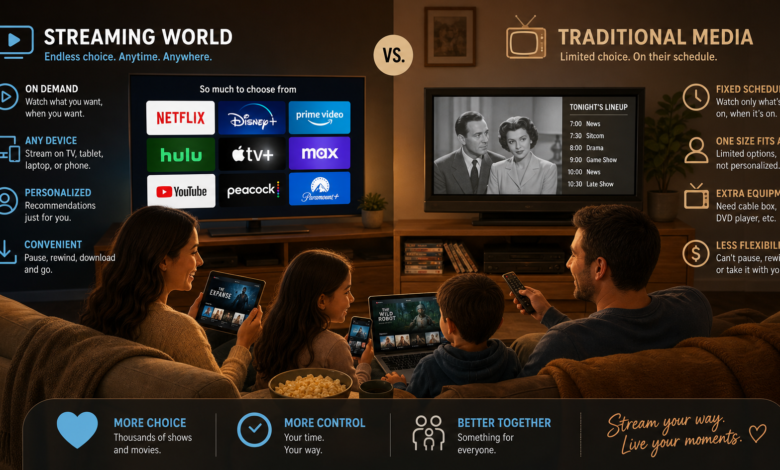
Video streaming platforms vs. traditional media is an important comparison for understanding how digital technology has changed the way people watch entertainment, follow news, and access information. Traditional media relies on established distribution methods such as broadcast television and cable networks, while streaming platforms deliver video content over the internet, often allowing viewers to choose what they watch and when they watch it.
Services such as YouTube and Netflix illustrate different approaches to online video distribution. Traditional television networks, meanwhile, continue to provide scheduled programming, live broadcasts, news coverage, and entertainment. Although both models deliver video to audiences, they differ in accessibility, content discovery, audience interaction, distribution, and revenue generation.
Understanding these differences helps viewers choose how to consume media and helps businesses, publishers, and creators decide where to distribute their content.
What Are Video Streaming Platforms?
Video streaming platforms deliver video over the internet so users can watch content on compatible devices without necessarily downloading the entire video file first. Depending on the service, users may stream movies, television series, live events, educational videos, news, or user-generated content.
Some platforms focus on on-demand entertainment. Netflix, for example, provides a subscription-based streaming service for films and television series. YouTube supports a broad range of creator-published videos, live streams, and other formats. Other services combine live television channels with internet-based streaming.
Streaming platforms commonly offer features such as search, recommendations, watchlists, playback controls, subtitles, and personalized profiles. The available features depend on the provider, subscription plan, device, and region.
Read Also:
What Are Content Platforms? Types, Examples, and How They Work
What Are Ecommerce Platforms? Types, Examples, and How They Work
What Are Digital Platforms? Types, Examples, and How They Work
What Is Traditional Media?
Traditional media refers to established forms of mass communication, including broadcast television, cable television, radio, newspapers, and print publications. When comparing video streaming platforms with traditional media, the most relevant comparison is usually with broadcast and cable television.
Traditional television distributes programming through broadcasting infrastructure or subscription television networks. Viewers often access scheduled channels, live news, sports, entertainment programs, and special events.
Some traditional broadcasters also operate websites and streaming applications. This means the distinction is not always between completely separate industries. Many media organizations now combine conventional broadcasting with digital distribution to reach audiences across multiple channels.
Video Streaming Platforms vs. Traditional Media: Key Differences
Although streaming services and traditional television both distribute video content, their operating models create different experiences for viewers and media businesses.
1. Content Access and Viewing Flexibility
One of the main differences between video streaming platforms and traditional media is when viewers can access content.
Traditional television often follows a programming schedule. Viewers may need to tune in at a particular time to watch a program live, although recording services and on-demand television options can provide additional flexibility.
Streaming platforms commonly allow viewers to select content on demand. A person can start a movie, pause it, resume it later, or watch an episode at a convenient time, subject to the service’s availability and access rules.
This flexibility is particularly useful for people with different schedules or viewers who prefer to watch complete seasons rather than follow weekly broadcasts. However, live streaming and some internet television services still use scheduled programming.
2. Distribution Technology
Traditional broadcast television typically relies on terrestrial broadcasting infrastructure, satellite transmission, or cable networks. The specific technology depends on the country and the television service.
Video streaming platforms distribute content over internet connections. Their delivery systems may use content delivery networks, video compression, adaptive streaming, and other technologies to provide playback across different devices and connection speeds.
Streaming quality can change according to available bandwidth, network congestion, device capabilities, and provider settings. Traditional television can also experience signal or service interruptions, but its delivery method differs from internet-based streaming.
For viewers, the practical distinction is that streaming usually requires a suitable internet connection and compatible application or device, whereas traditional television may be available through a television antenna, cable connection, or satellite receiver.
3. Device Compatibility and Accessibility
Traditional television is primarily associated with television sets and dedicated reception equipment, although broadcasters increasingly provide additional viewing options.
Streaming platforms can often be accessed through smart TVs, smartphones, tablets, computers, and streaming devices. This makes it possible to watch content in different locations and switch between devices when the service supports it.
However, access is not universal. Streaming may require a paid subscription, an account, a supported device, or sufficient internet connectivity. Content can also be restricted by geography or licensing agreements.
Traditional television remains valuable in areas where internet access is limited or where viewers prefer the simplicity of scheduled channels.
4. Content Discovery and Recommendations
Traditional television generally organizes content through channels, electronic program guides, scheduled listings, and promotional announcements.
Streaming platforms typically combine search tools with digital catalogs, categories, watchlists, and recommendation systems. Some services personalize suggestions using viewing activity and other available signals.
These features can help viewers discover programs beyond their usual preferences. At the same time, recommendation systems may repeatedly highlight similar content or make it difficult to discover material outside a viewer’s established interests.
Traditional television schedules can also introduce audiences to programs they might not have searched for independently. Each model therefore offers a different approach to discovery.
5. Audience Interaction
Traditional television has historically provided a largely one-way viewing experience. Viewers watch programs, while direct interaction with broadcasters is usually limited to separate channels such as phone calls, websites, or social media.
Digital video platforms can support comments, likes, shares, subscriptions, live chats, polls, and creator communities. These features allow some audiences to interact with content and its publishers more directly.
However, interaction depends on the platform and content type. A subscription-based streaming service focused on films may offer limited social features, while a creator platform or live-streaming service may encourage extensive participation.
The difference is not simply that digital media is interactive and traditional media is not. Rather, online platforms can integrate audience participation directly into the viewing environment.
6. Content Creation and Distribution Opportunities
Traditional television production and distribution have often involved broadcasters, production companies, professional crews, and established commissioning or licensing arrangements.
Digital platforms have lowered some barriers to publishing video. Individual creators, educators, small businesses, and independent media organizations can upload content without necessarily securing a traditional broadcasting agreement.
YouTube illustrates this model by allowing eligible creators to publish videos and build channels. However, publishing access does not guarantee that a video will reach a large audience. Competition, platform policies, audience interest, production quality, and recommendation systems all affect visibility.
Traditional broadcasters retain advantages in areas such as established production capabilities, professional news operations, large-scale live coverage, and access to certain licensed content.
7. Advertising and Revenue Models
Traditional television commonly generates revenue through advertising, subscriptions, public funding, or combinations of these sources. Advertising is often sold around scheduled programs, audience demographics, and estimated viewership.
Streaming platforms use several models. Some charge subscriptions, some rely on advertising, and others combine paid plans with advertising-supported access. Certain platforms also provide eligible creators with advertising revenue-sharing or other monetization options.
For media companies, digital distribution can provide additional ways to reach audiences and measure engagement. Yet online revenue depends on factors such as viewing activity, advertising demand, subscription arrangements, licensing rights, and platform policies.
Neither model guarantees higher revenue. The most suitable approach depends on the audience, content, distribution costs, and business strategy.
Comparison Table: Streaming Platforms vs. Traditional Television
| Feature | Video Streaming Platforms | Traditional Television |
|---|---|---|
| Viewing schedule | Often on demand; some live content | Commonly scheduled programming |
| Distribution | Internet-based delivery | Broadcast, cable, or satellite |
| Devices | Smart TVs, phones, tablets, computers, and supported devices | Television sets and compatible reception equipment |
| Content discovery | Search, catalogs, recommendations, and feeds | Channels, program guides, and schedules |
| Audience interaction | May include comments, live chat, and sharing | Historically more limited within the viewing experience |
| Publishing access | Some platforms allow independent creators to publish | Generally depends on broadcaster or network access |
| Revenue models | Subscriptions, advertising, and other digital models | Advertising, subscriptions, public funding, and other models |
| Connectivity | Requires internet access for online streaming | Depends on the delivery system; internet may not be necessary |
These are general tendencies rather than universal rules. Some streaming services are entirely subscription-based, some broadcast networks offer on-demand applications, and some internet television services reproduce traditional channel schedules.
Advantages of Video Streaming Platforms
Video streaming platforms offer several advantages for viewers and content publishers.
Flexible viewing: On-demand services allow users to choose programs and watch them at convenient times when the content is available.
Access across devices: Many services support multiple device types, allowing viewers to move between a television, computer, or mobile device.
Broad content selection: Online catalogs may include international productions, independent creators, educational videos, niche subjects, and specialized entertainment.
Content discovery tools: Search, categories, recommendations, and subscriptions help users navigate large collections of videos.
Opportunities for creators: Certain platforms enable individuals and smaller organizations to distribute video without relying exclusively on traditional broadcasters.
These benefits vary by service, and users may face subscription costs, advertisements, regional restrictions, or changing content catalogs.
Advantages of Traditional Media
Traditional television continues to offer benefits that are relevant even as streaming grows.
Live programming: Broadcast and cable networks remain important for live news, sports, elections, and major public events.
Established production infrastructure: Many broadcasters have experienced production teams, studios, correspondents, and systems for covering events at scale.
Simple access in some settings: Viewers with suitable reception equipment can watch television without depending on a broadband internet connection.
Shared viewing experiences: Scheduled programs can bring large audiences together at the same time, creating common cultural moments.
Editorial structures: Established news organizations may have formal editorial processes and accountability systems, although standards vary between organizations and markets.
Traditional media also faces limitations, including fixed schedules, distribution constraints, and competition from digital services. Its advantages depend on the broadcaster, content, and local viewing environment.
Challenges and Limitations of Streaming Platforms
Despite their flexibility, video streaming platforms face several challenges.
Reliable playback depends on internet connectivity, and high-quality video may consume substantial data. Users may also need several subscriptions to access content distributed across different services.
Content availability can change because of licensing agreements, regional restrictions, and business decisions. Recommendation systems may influence what users see, while creators can be affected by changes to platform policies and monetization rules.
For businesses and publishers, streaming can provide access to audiences but also create dependence on third-party distribution systems. Maintaining a website, email list, or other direct communication channel can help reduce reliance on a single platform.
Are Streaming Platforms Replacing Traditional Media?
Video streaming platforms have changed viewing habits and increased competition for traditional television, but they have not made every form of traditional media obsolete.
Many viewers combine different services according to their needs. They may use streaming subscriptions for films and series, video-sharing platforms for tutorials, and traditional television for live news or sports. Broadcasters have also expanded into digital applications and on-demand services.
The relationship between streaming and traditional media is therefore better understood as a shift in distribution and audience behavior than as a complete replacement of one model by another.
Media organizations increasingly need to consider where their audiences spend time, which formats they prefer, and how content can be distributed effectively across different channels.
How Businesses and Creators Should Choose Between Them
The right distribution method depends on the content and the intended audience.
Creators producing tutorials, reviews, entertainment, or educational videos may benefit from online platforms that support search, subscriptions, and audience engagement. Media organizations with established broadcast operations may continue to rely on television while distributing selected content through streaming applications.
Businesses should consider audience reach, production requirements, distribution costs, monetization options, measurement tools, and control over their content. They should also examine whether the audience uses a particular platform and whether the format fits the message.
In many cases, a combined strategy can be more effective than choosing only one channel. Traditional broadcasting can provide broad or live coverage, while streaming and social video can support on-demand access, niche audiences, and ongoing engagement.
The best decision is the one that aligns the distribution method with the content, available resources, and audience expectations.
The Future of Video Streaming Platforms and Traditional Media
Video streaming platforms and traditional media are increasingly connected through hybrid distribution strategies. Broadcasters operate streaming services, streaming companies invest in original productions, and creators distribute content across several digital channels.
Technology continues to influence video discovery, delivery, personalization, and monetization. At the same time, audiences still value reliability, relevant programming, trustworthy information, and convenient access.
For businesses, creators, and media organizations, understanding both models is essential to developing a practical distribution strategy. Streaming offers flexibility and new publishing opportunities, while traditional media retains strengths in scheduled programming, live coverage, and established production infrastructure.
Rather than treating these models as complete opposites, it is more useful to understand how each serves different audiences and how they can complement one another in the broader digital media ecosystem.